
Professional, qualified accountants
Your file is handled by experienced professional accountants who work to Canadian accounting and assurance standards, not seasonal preparers. Every return and financial statement is reviewed before it is filed.
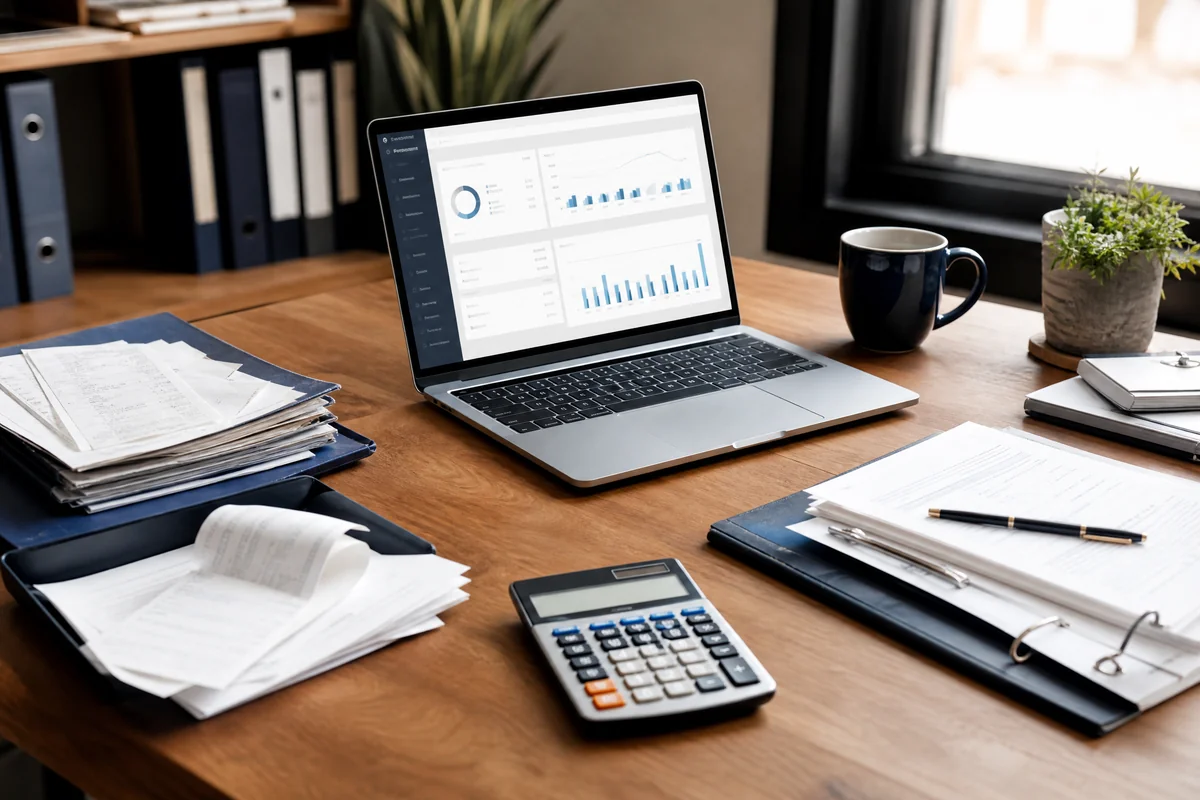
Practical guidance on keeping clean, audit-ready books for your Saskatchewan small business — and using your numbers to make better decisions.
Clean, accurate, up-to-date books are the foundation of every successful Saskatchewan business. They tell you whether you are truly profitable, give you the numbers to make confident decisions, keep you compliant with the CRA, and make tax time fast and inexpensive rather than painful. This guide from BOMCAS Canada explains the bookkeeping basics every small business owner should understand — and how to build a simple, reliable system that grows with you.
Many small business owners treat bookkeeping as an afterthought — a shoebox of receipts dealt with once a year. That approach is expensive in every sense: it leads to missed deductions, cash-flow surprises, GST errors, stressful tax seasons and higher accounting fees. By contrast, owners who keep their books current enjoy clarity, control and peace of mind. The good news is that with the right habits and tools, good bookkeeping is well within reach for any business.
The single most important first step is to open a dedicated business bank account and, ideally, a business credit card. Mixing personal and business transactions is the most common bookkeeping mistake we see, and it causes endless reconciliation headaches, weakens your records if the CRA reviews them, and can blur the legal separation that incorporation is meant to provide. From day one, run every business dollar through business accounts.
Most small businesses use the accrual method, which records income when earned and expenses when incurred, giving a truer picture of performance than simply tracking cash in and out. Modern cloud accounting software — such as QuickBooks Online or Xero — automates much of the heavy lifting: it connects to your bank, imports transactions, categorises them, and produces financial statements at the click of a button. We help clients select and set up the right platform for their needs, then train them to use it efficiently.
The heart of bookkeeping is recording every transaction in the correct category on a regular schedule — weekly is ideal for most small businesses. Consistency matters more than perfection: a little time each week prevents a mountain of work later. Categorise income by source and expenses by type (supplies, rent, utilities, professional fees, vehicle, marketing and so on) so that your reports are meaningful and your tax return is straightforward.
The CRA requires businesses to keep supporting documents for their claims, generally for six years. Digital copies are acceptable, so use your phone or software to photograph and attach receipts to transactions as they happen. Good documentation is what turns a legitimate expense into a defensible deduction. Without it, an otherwise valid expense can be denied on review.
Reconciliation means matching your books to your bank and credit card statements to ensure nothing is missing, duplicated or miscategorised. Monthly reconciliation catches errors early, prevents fraud from going unnoticed, and guarantees your financial statements are accurate. It is one of the highest-value habits a business owner can build, and cloud software makes it faster than ever.
If you are registered for GST, your bookkeeping must separate the tax you collect from the tax you pay so you can file accurate returns and claim input tax credits. If you have employees, payroll must be tracked precisely, with source deductions remitted on time. Build your filing and remittance deadlines into your calendar — our Canadian tax deadlines guide lays them out — so obligations never sneak up on you.
Bookkeeping is not just about compliance; it is about insight. Each month, look at your profit and loss statement and your cash position. Are sales trending up? Which expenses are creeping? Do you have enough cash for upcoming tax and payroll obligations? These questions are easy to answer when your books are current, and they are the difference between reacting to problems and steering your business proactively.
Many owners start by doing their own bookkeeping and reach a point where their time is better spent running the business. Others want confidence that everything is correct from the outset. Either way, professional bookkeeping pays for itself through saved time, captured deductions, fewer errors and lower year-end accounting costs. At BOMCAS Canada, we offer full-service and supporting bookkeeping for Saskatchewan businesses, from monthly reconciliations to complete back-office management, all on secure cloud platforms you can access anytime.
To set up a bookkeeping system that keeps you compliant, organised and informed, explore our bookkeeping services or book a free consultation. We serve businesses in every community across Saskatchewan, in person and online.
Important: This guide is general information for Saskatchewan taxpayers and businesses and is not a substitute for personalised professional advice. Tax rules change and every situation is different. For advice specific to your circumstances, contact BOMCAS Canada for a free consultation.
When you engage BOMCAS Canada for accounting and tax services in Saskatchewan, you work with a professional firm that takes responsibility for getting the details right. Below is what that commitment looks like in practice, and how a typical engagement works from your first call to ongoing year-round support.
Your file is handled by experienced professional accountants who work to Canadian accounting and assurance standards, not seasonal preparers. Every return and financial statement is reviewed before it is filed.
We work with the full Saskatchewan tax picture every day — the 5% federal GST and the 6% Saskatchewan PST, Saskatchewan personal tax brackets, provincial credits, and the federal rules that sit on top of them — so nothing is missed and nothing is misapplied.
You receive a clear scope and a fixed-fee quote before any work begins. There are no surprise invoices and no vague hourly meters — you always know what you are paying and what it covers.
We are available throughout the year for questions, planning and CRA correspondence, so decisions can be made with proper advice rather than guesswork between filing deadlines.
With your authorisation we deal directly with the Canada Revenue Agency on your behalf — responding to reviews, adjustments and audit queries — and keep you informed at each step so you are never left guessing.
Documents are exchanged through secure digital channels, and the entire engagement can be handled remotely. Whether you are in a city centre or a rural community, you receive the same standard of service.
Book a complimentary, no-obligation consultation with BOMCAS Canada. We serve individuals, professionals and businesses across every community in Saskatchewan — in person and remotely.
BOMCAS Canada
Typically replies within 1–2 business days
Hi there! 👋 Send us a message below and a member of our team will get back to you within 1–2 business days.